
Why Syntax Accuracy Matters
Unlike browser rendering engines that frequently correct minor HTML errors automatically, robots.txt parsers are unforgiving. While modern parsers are designed to skip unrecognized directives without crashing, a subtle syntax flaw—such as a missing colon, an orphaned directive, or invisible non-printing characters—can invert your intended crawl logic, accidentally blocking your most profitable organic pages.
In this guide, we review the formal grammar rules established by RFC 9309 and walk through common syntax blunders that derail technical SEO audits.
The Formal Grammar of RFC 9309
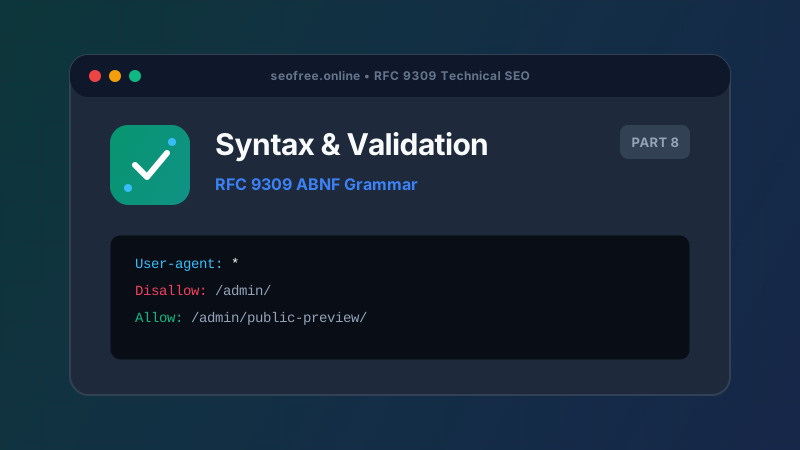
RFC 9309 defines robots.txt syntax using Augmented Backus-Naur Form (ABNF). Key grammatical constraints include:
- Field-Name and Field-Value Separator: Directives must be followed immediately by a colon (
:) and optional whitespace.Disallow /admin/without a colon is invalid and will be ignored. - Line Endings: Compliant parsers accept standard Unix LF (
\n), legacy Mac CR (\r), or standard Windows CRLF (\r\n). - Character Encoding: The file MUST be encoded in UTF-8. UTF-16, UTF-32, or legacy ANSI encodings with Byte Order Marks (BOM) can cause parsers to fail reading the first directive.
Top 5 Syntax Traps Caught in Audits
1. Orphaned Directives Outside User-Agent Groups
Every Allow or Disallow rule must belong to an active User-agent group. Placing directives at the top of the file before any User-agent line is a syntax error:
# INCORRECT: Disallow has no associated crawler group
Disallow: /admin/

User-agent: *
Allow: /
The parser will drop the initial Disallow rule entirely because it cannot determine which crawler group owns it.
2. Path Formatting: Missing Leading Slash
RFC 9309 mandates that path values for Allow and Disallow must begin with a forward slash (/) or an asterisk (*):
# INCORRECT
Disallow: admin/

# CORRECT
Disallow: /admin/
3. Deprecated Directives (Noindex and Crawl-Delay)
Many legacy robots.txt files still contain non-standard lines like Noindex: /private/ or Crawl-delay: 10. Google has officially stated that noindex in robots.txt is unsupported and ignored. While Bing recognizes Crawl-delay, Googlebot disregards it completely.
4. Invisible Unicode and BOM Artifacts
Copy-pasting directives from rich-text editors (such as Microsoft Word, Slack, or Apple Notes) frequently introduces curly quotes, non-breaking spaces (\u00A0), or UTF-8 BOM characters. These non-printable artifacts will cause directive names to fail string matching.
5. Unescaped Colons in URL Paths
If a disallowed path contains a colon (for example, /item/sku:12345), ensure the path is structured properly so the parser does not misidentify the second colon as another field separator.
How to Validate Your Syntax Instantly
Use our Bulk Robots.txt Tester. Our RFC 9309 engine automatically parses lines, identifies syntax warnings (such as missing colons or orphaned directives), extracts sitemap declarations, and separates unsupported instructions from active crawl rules.
Frequently Asked Questions
Are comments permitted in robots.txt?
Yes. Comments begin with an octothorpe (#) and can appear on their own line or inline after a directive. Everything following the # character on that line is ignored by the parser.
Can I have blank lines between directives?
Yes. Blank lines are ignored and are commonly used to separate distinct User-agent groups for visual clarity.
What is the maximum file size for robots.txt?
Under RFC 9309, crawlers must support robots.txt files up to at least 512 KiB (524,288 bytes). Any content beyond this threshold may be truncated and ignored.