

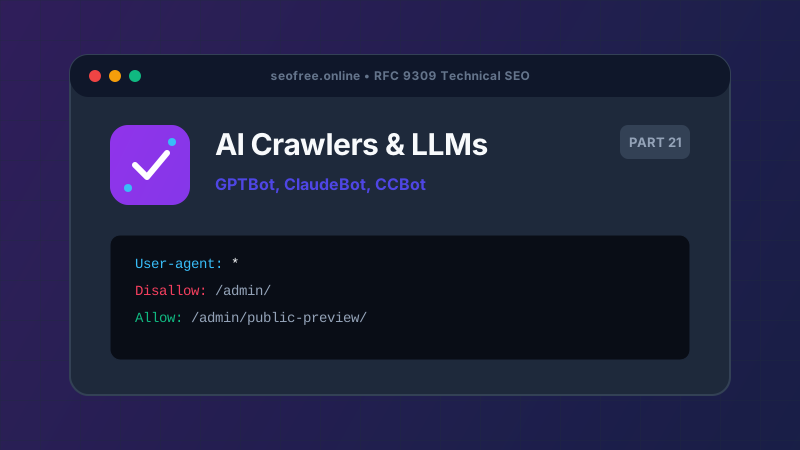
The Explosion of Generative AI Crawlers
In recent years, the landscape of automated web crawling has undergone its most dramatic transformation since the inception of Google. Companies training Large Language Models (LLMs) and deploying conversational search engines deploy specialized bots to scrape editorial content, documentation, and product catalogs.
Fortunately, leading AI organizations have adopted RFC 9309 standards, respecting robots.txt directives and publishing dedicated crawler product tokens. This allows webmasters to granularly allow traditional search engine indexing while restricting unauthorized AI model training.
Directory of Major AI Crawler User-Agent Tokens
| Organization | Crawler User-Agent Token | Primary Function |
|---|---|---|
| OpenAI | GPTBot |
Scrapes content to train OpenAI generative models (GPT-4, etc.) |
| OpenAI | OAI-SearchBot |
Fetches real-time web content for SearchGPT / ChatGPT web search |
| Anthropic | ClaudeBot |
Scrapes training and citation data for Claude models |
Google-Extended |
Controls data training for Gemini without affecting Google Search | |
| Perplexity | PerplexityBot |
Crawls web content to answer real-time conversational search queries |
| Common Crawl | CCBot |
Open web data repository utilized by numerous independent AI researchers |
Strategy 1: Blocking AI Training While Allowing Search Engine Indexing
If you want your website to rank normally in Google and Bing, but want to prevent your original content from being used to train generative AI models without compensation, add dedicated blocks for AI tokens:
# Allow standard search engine crawling
User-agent: *
Disallow: /admin/
Disallow: /private/

# Disallow AI model training crawlers
User-agent: GPTBot
Disallow: /

User-agent: ClaudeBot
Disallow: /

User-agent: Google-Extended
Disallow: /

User-agent: CCBot
Disallow: /Google-Extended does NOT impact your rankings in Google Search. Google-Extended governs AI model training and Gemini features, while standard Google Search continues to use Googlebot.
Strategy 2: Distinguishing AI Search from AI Training
Companies like OpenAI now differentiate between offline model training and real-time citation search. If you want ChatGPT users to receive citations and links to your website in real-time answers, you can allow OAI-SearchBot while blocking GPTBot:
# Block AI training
User-agent: GPTBot
Disallow: /

# Allow real-time search and citations
User-agent: OAI-SearchBot
Disallow: /admin/
Allow: /
Testing AI Crawler Permissions
Because crawler tokens follow strict group selection under RFC 9309, you must verify that your custom AI blocks do not inadvertently inherit unintended rules or conflict with wildcard directives. Test your rules against custom crawler tokens using our Bulk Robots.txt Tester.
Frequently Asked Questions
Will blocking GPTBot hurt my Google SEO?
No. GPTBot is operated exclusively by OpenAI for model training and has zero connection to Google’s search ranking algorithms.
Do all AI bots respect robots.txt?
Major ethical AI companies (OpenAI, Anthropic, Google, Microsoft, Meta) adhere strictly to RFC 9309. However, unregulated or rogue scrapers may ignore robots.txt and require server-level Web Application Firewall (WAF) blocking.
Can I block AI crawlers from specific sections only?
Yes. Just like any search engine, you can allow AI crawlers on public marketing pages while disallowing them from proprietary research or premium archives.